Frameworks, standards, and control catalogs give risk programs structure. See how ISO/IEC 27001, ISO 31000, NIST, COSO ERM, and CMMC differ, and how to choose among them.
Risk Management Frameworks and Standards: What They Are and Why They Matter
Nov. 12, 2026, was a day most of us would like to forget.
Just after lunchtime and with little warning, organizations around the world found themselves suddenly without the use of a bunch of the tools they depend on to get work done. A major Microsoft 365 outage took out Outlook, Teams, Copilot, and a few other services, keeping users from sending emails, managing calendars, and attending meetings.
The outage lasted a little over 24 hours and disrupted businesses, government agencies, airlines, financial institutions, and other organizations worldwide. For such a widespread and damaging event, there was very little drama involved. This wasn’t the result of some state-sponsored cyberattack or a catastrophic natural disaster. Microsoft attributed the disruption to a months-old, “lock contention” bug in Microsoft 365 networking gateway servers triggered by a sudden surge in traffic. Yawn. But also, ugh.
Even though there’s no evidence of malicious activity, the Day Without Outlook looks an awful lot like the kind of mayhem good security and governance teams spend much time preparing for when it comes to reliance on a critical third-party partner or vendor. The incident played all the hits: Loss of availability of important systems; breakdown of normal workflows; use of unauthorized workarounds as employees scramble for alternatives to do their jobs.
It’s a prime object lesson in why risk management needs to be about more than just keeping hackers out. Comprehensive risk management must cover any threat of operational failure, vendor disruption, regulatory change, human error, natural events, and any other uncertainties that can disrupt the business or spawn financial, legal, or reputational consequences.
While you can’t ward off every injurious event, you can develop disciplined ways to identify risks and understand their potential ramifications. That’s where risk management frameworks, standards, and other formal guidance come in. They provide the structure for managing and mitigating risk as well as for continually evaluating whether your safeguards and contingency plans remain adequate in an ever-shifting risk environment.
What are risk management frameworks?
Risk management guidance is all about answering some core, organization-specific questions with regard to our digital assets: What could go wrong? How bad would it be? What protections do we need right now? Who’s responsible for them? How do we know those controls are working?
Different risk management methodologies answer these questions in different ways.
Formal risk standards, for example, establish requirements for managing information security, while a risk control catalog focuses more on specific safeguards organizations can choose and implement. A full-throated enterprise risk framework, meanwhile, is built to help organizational leaders connect risk to the business’s strategy and objectives. A maturity model may sit along-side any of the above to measure whether necessary cybersecurity and governance practices have been well implemented.
This is also where terminology can get a bit confusing. The National Institute of Standards and Technology (NIST), for example, has a specific methodology called the Risk Management Framework (RMF). The NIST RMF describes seven steps: Prepare, Categorize, Select, Implement, Assess, Authorize, and Monitor. NIST SP 800-53 supplies the security and privacy control catalog used within that process.
We’ll talk about NIST more specifically below, but throughout this article, we’ll also discuss “risk management frameworks” more broadly as a reference to all of the standards, control catalogs, and other guidance organizations typically use to manage and mitigate risk.
Bottom line: Risk management frameworks and related guidance provide structured ways to identify, assess, respond to, and monitor risk. They may take the form of standards, frameworks, control catalogs, or maturity models. While methods differ, these methodologies help organizations replace inconsistent risk decisions with repeatable processes and clearly defined controls.
Why are risk management frameworks important?
Without a consistent approach, risk management quickly gets subjective, chaotic, and decidedly less effective. One line-of-business unit in your company may classify a risk as critical while another sees such exposure as minor. Without formal risk guidelines, controls get implemented without clear objectives. Even worse, important risks remain unaddressed usually because nobody’s explicitly responsible for dealing with them.
Risk management guidance creates a common taxonomy that’s vital to an organized approach. These tools establish how risks are identified and prioritized. They dictate which controls are selected and implemented. They assign ownership of specific responsibilities, determine what evidence is to be retained, and they detail how frequently risks must be reassessed to ensure ongoing compliance.
Frameworks also make risk management easier to explain and defend to executive leadership. No small task. Unlike security and governance practices created from scratch, framework-based risk management lets organizations align their programs with established guidance developed by standards bodies, government agencies, industry groups, and other recognized authorities.
That kind of hefty endorsement pays big dividends when boards, auditors, regulators, insurers, customers, or business partners want evidence that the company’s risk is being managed methodically and systematically.
Bottom line: Risk management frameworks bring consistency, accountability, and repeatability to risk decisions. They help organizations prioritize limited resources, establish appropriate controls, assign ownership, and demonstrate due diligence. Instead of reacting to risks individually, organizations can build a repeatable process for identifying exposures, mitigating them, and monitoring whether those efforts remain effective.
How do risk management frameworks actually help mitigate risk?
Adoption of frameworks and standards won’t magically reduce risk. The value of these tools comes from their ability to accelerate risk management from concept to action.
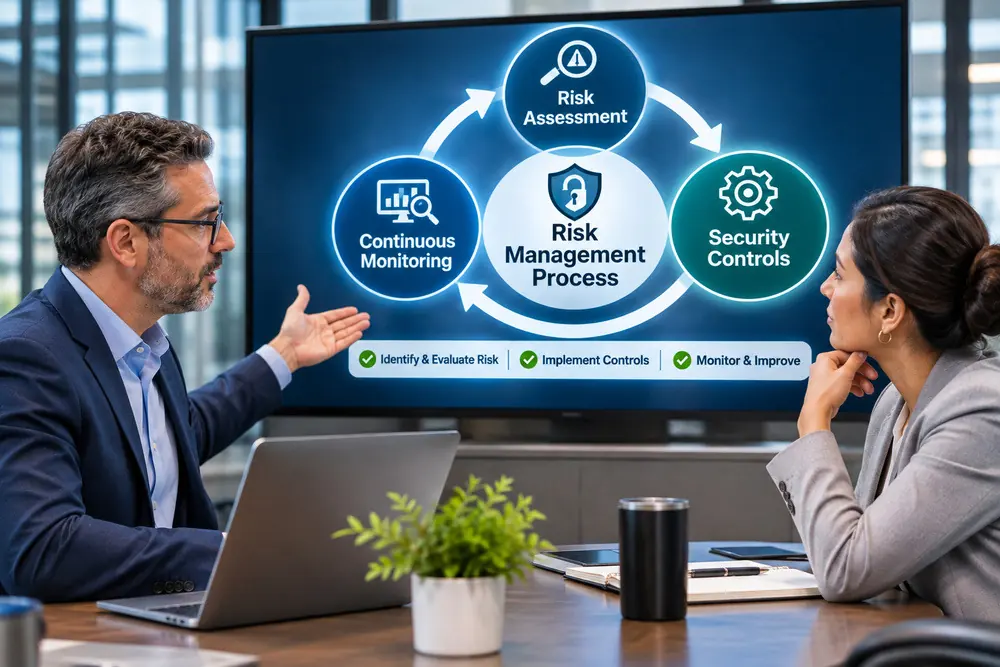
Let’s say your company is worried about unauthorized access to sensitive, proprietary product information. A risk management process would identify the affected assets, assess the likelihood and potential impact of unauthorized access, and determine which additional protections, if any, are needed. Relevant guidance can then help define appropriate controls, things like stronger authentication, access reviews, account management procedures, logging, employee training, or periodic controls testing.
Armed with the insights these risk frameworks and standards provide, security and governance leaders can assign owners, implement controls, measure them to see if they are working, and reassess any remaining risk. If that residual risk is still too great, additional mitigation can be added.
It’s this management and mitigation lifecycle that makes structured risk management so powerful. Controls can be seen as well-accounted responses to identified and prioritized risks rather than isolated security activities of questionable provenance with a lack of ownership.
Bottom line: Risk management frameworks help mitigate risk by connecting identified threats and exposures to appropriate responses and controls. The RMF gives organizations a formal way to prioritize risks, implement protections, assign owners, assess control effectiveness, and monitor residual risk. Frameworks, standards, and other formal guidelines supply the structure; real mitigation happens when organizations turn that guidance into implemented, tested, and continuously reviewed controls.
Now let’s look at some of the specific risk management guidance available to security and governance professionals today.
How do ISO/IEC 27001 and ISO/IEC 27002 manage information security risk?
ISO/IEC 27001 and ISO/IEC 27002 from the Swiss-based International Organization for Standardization governing body are closely related but serve distinctly different purposes.
ISO/IEC 27001 details the requirements for establishing, implementing, maintaining, and continually improving an Information Security Management System, or ISMS. The standard gives companies of any size and vertical a formal way to establish, implement, maintain, and continually improve their ISMS. Meeting the ISO/IEC 27001 standard shows that an organization has a system to manage risks related to the security of data it owns or handles. The ISMS provides a systematic way to manage risks that affect the so-called CIA data security triad (confidentiality, integrity, and availability). Organizations can be certified for ISO/IEC 27001.
ISO/IEC 27002 complements the above standard with guidance and recommended information security controls. Those controls address areas like access control, cryptography, human-resource security, incident response, and protection of information assets.
Together, the ISO/IEC 27001 and 27002 standards connect information-security risk management with a structured management system and a practical set of controls.
Bottom line: ISO/IEC 27001 establishes requirements for an information security management system, while ISO/IEC 27002 provides detailed guidance on information security controls. Used together, they help organizations identify information risks, select appropriate protections, establish accountability, and continually improve how sensitive information and supporting systems stay secure.
How does ISO 31000 support enterprise risk management?
Also, a product of the International Organization for Standardization, ISO 31000 takes a broader view of risk management, going beyond information-security-specific guidance.
The current ISO 31000 provides principles and guidelines for identifying, analyzing, evaluating, treating, monitoring, and communicating risk throughout an organization. Among the strengths of this international standard is integration. Rather than treating risk management as a discrete, specialized activity performed by a single unit within the organization, ISO 31000 encourages businesses to incorporate risk into governance, compliance, strategy, planning, decision-making, policies, culture, reporting, and more.
This approach works especially well in enterprise risk management. ISO 31000 maintains the perspective that any cybersecurity incident, supplier failure, regulatory change, or operational disruption can originate in one part of the business but create consequences throughout the organization. Contextualizing that broader risk environment helps business leaders and security teams look beyond the concerns of a single line of business and evaluate risks according to their potential impact at large.
Bottom line: ISO 31000 provides organization-wide principles for identifying, assessing, treating, monitoring, and communicating risk. Its broad approach helps organizations integrate risk management with governance and decision-making, ensuring that risks are evaluated in their wider business context rather than being isolated within individual departments, functions, or technical systems.
How does the NIST Risk Management Framework (RMF) help organizations manage security and privacy risk?
The NIST Risk Management Framework, as defined in SP 800-37 Rev. 2, provides a structured process for managing security and privacy risk throughout an information system’s life cycle. Rather than simply listing controls, the RMF tells organizations with great specificity how to organize the overall risk management process.
The RMF’s seven steps (Prepare, Categorize, Select, Implement, Assess, Authorize, and Monitor) were purpose built to help defenders understand their systems and risks, select the best protections, determine whether those controls are working as intended, make informed decisions, and continuously monitor changes that might impact affect risk.
The framework is closely connected to NIST SP 800-53, which provides the security and privacy controls organizations can select and tailor as part of the RMF process. NIST describes the RMF as a disciplined, structured, and flexible approach that links system-level risk management with broader organizational risk decisions.
Bottom line: The NIST RMF provides a seven-step process for managing security and privacy risk across the system life cycle. It defines how organizations prepare, categorize systems, select and implement controls, assess their effectiveness, monitor ongoing risk exposure.
How does NIST SP 800-53 support the NIST RMF?
NIST SP 800-53 is best described as a comprehensive catalog of security and privacy controls rather than a standalone risk management framework or standard.
The controls addressed in SP 800-53 cover access control, configuration management, incident response, contingency planning, personnel security, risk assessment, system integrity, supply chains, privacy, and more. NIST describes SP 800-53’s controls as flexible and customizable, so organizations can select and tailor them according to their profiles and requirements.
SP 800-53’s most recent revision (Revision 5) also made the catalog more outcome-oriented and separated controls from the process used to select them. That lets SP 800-53 support different risk management approaches rather than limiting them to one specific implementation model. Organizations select SP 800-53 controls based on their risk assessments and then implement, assess, authorize, and continuously monitor those protections.
Bottom line: NIST SP 800-53 provides a broad, customizable catalog of security and privacy controls organizations can use to address identified risks. It supports the NIST Risk Management Framework but can also inform other programs. Its outcome-focused controls help organizations translate risk decisions into specific, assessable security and privacy protections.
How does the COSO ERM Framework connect risk to business strategy?
The Enterprise Risk Management Framework from the Committee of Sponsoring Organizations of the Treadway Commission (COSO) approaches risk from an executive and enterprise perspective.
It organizes enterprise risk management around five interconnected components: Governance and Culture; Strategy and Objective-Setting; Performance; Review and Revision; and Information, Communication, and Reporting. Within those areas are principles that cover approaches like board risk oversight, defining risk appetite, identifying and prioritizing risks, implementing responses, and reviewing performance.
COSO’s stated goal with their ERM is to ensure enterprise risk management is more than just a compliance exercise. COSO encourages organizations to consider risk while setting business strategy and pursuing business objectives. That helps make risk information part of corporate decision-making rather than something to be reviewed only after decisions have been made.
Bottom line: COSO ERM helps organizations integrate risk with governance, strategy, performance, and decision-making. Instead of viewing risk management as a separate compliance function, it encourages leaders to consider risk while establishing objectives and evaluating performance, creating an enterprise-wide view of how uncertainty can affect organizational strategy and results.
How does CMMC help address cybersecurity risk?
The Cybersecurity Maturity Model Certification, or CMMC, was crafted specifically to cover the supply chain that supports the U.S. Department of Defense (or Department of War, if you prefer).
CMMC assesses whether contractors have effectively implemented infosec protections required for systems handling Federal Contract Information (FCI) and Controlled Unclassified Information (CUI). The current CMMC uses three levels, with assessment requirements increasing according to the sensitivity of the information and contractual requirements. Current Defense Federal Acquisition Regulation Supplement (DFARS) rules recognize Level 1, Level 2, and Level 3 CMMC statuses.
Unlike the broader enterprise guidance we discussed earlier, such as ISO 31000 or COSO ERM, the CMMC addresses a specific cybersecurity and contractual risk environment. Organizations in the so-called Defense Industrial Base (DIB) need to understand which CMMC requirements apply to the systems involved in performing their contracts and demonstrate that required safeguards are in place.
Bottom line: CMMC provides a structured way for DoD contractors to demonstrate required cybersecurity protections for FCI and CUI. Its three levels apply increasingly stringent requirements according to contractual and information-protection requirements, helping the defense supply chain verify that organizations handling sensitive government information maintain robust safeguards.
How can organizations best choose among the various risk management frameworks?
As is probably clear by now, there is no single framework that’s best for every organization. Each of the sets of guidelines we’ve discussed solves a different set of problems.
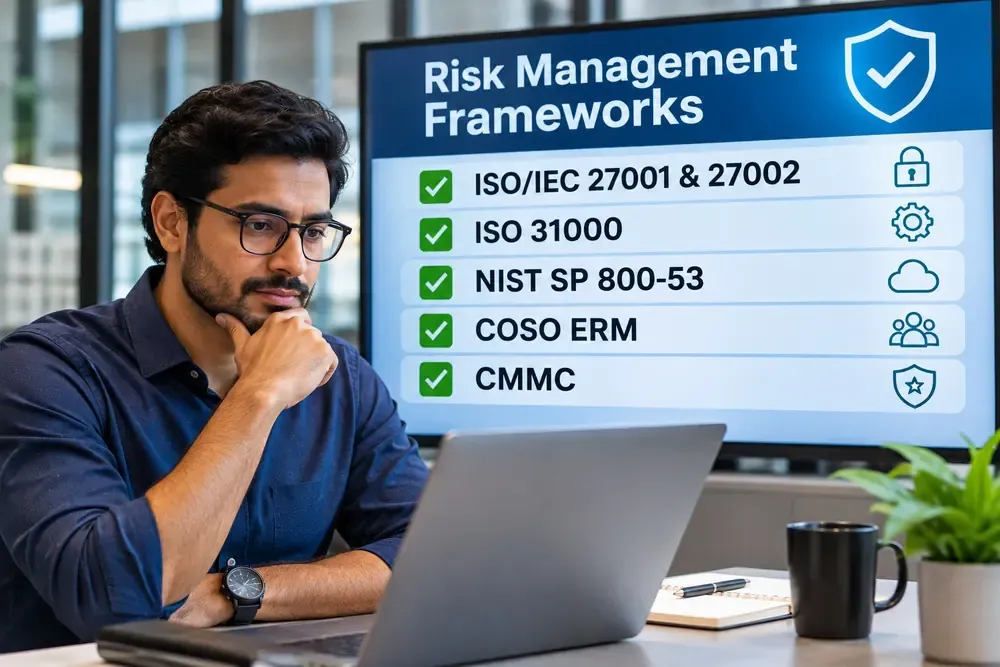
A company looking for an internationally recognized infosec management system might prioritize ISO/IEC 27001, for example. Another seeking broad enterprise risk guidance might find ISO 31000 or COSO ERM more appropriate. Organizations operating in federal environments will likely rely heavily on NIST guidance, while defense contractors will almost certainly have specific CMMC obligations to meet.
Many organizations will use more than one.
The challenge here is making sure overlapping guidance doesn’t result in duplicated work. The same access-control process, for example, may satisfy requirements in several standards or frameworks. Treating each requirement separately can result in repeated testing, evidence gathering, and remediation. That makes mapping controls across frameworks extremely important to ensuring both effectiveness and efficiency.
Bottom line: Organizations should choose risk management guidance based on their vertical industry, regulatory obligations, business objectives, risk profile, and compliance requirements. Many organizations need to manage several frameworks at once. The key to success is selecting the most relevant guidance and identifying where common controls can satisfy overlapping requirements.
How can GRC technology help manage multiple risk management frameworks?
As organizations adopt multiple risk standards, frameworks, and guidance, keeping all of the risks, controls, owners, assessments, test results, and supporting evidence aligned gets increasingly complicated.
A GRC platform like SimpleRisk provides a central environment for managing much of the risk management overhead. Organizations can maintain a risk register, assign owners, apply scoring methodologies, document mitigation plans, schedule ongoing reviews, and track how their risks change over time.
SimpleRisk also supports compliance frameworks and controls. Users can define controls, map controls to requirements in other frameworks, define tests against those controls, schedule and perform audits, record results, and attach supporting evidence. Failed control tests can be linked to risks so weaknesses identified through compliance activities can be tracked through the risk-management process.
As we noted above, cross-framework controls mapping can be especially useful when several standards are tackling similar requirements. Instead of maintaining separate evidence and testing processes for every framework, organizations can map related requirements to common controls and reuse relevant tests and evidence where appropriate. SimpleRisk also offers optional integrations with pre-mapped controls libraries such as the Secure Controls Framework (SCF) and Unified Compliance Framework (UCF).
Using these mappings as starting points, organizations can identify controls overlap, reduce duplication, and keep relationships among risks, controls, tests, evidence, and frameworks all discoverable and visible on a single platform.
Bottom line: GRC technology can help organizations put risk management guidance into practice by organizing risks, controls, owners, testing, evidence, and mitigation activity. SimpleRisk also supports cross-framework control mapping, which can help teams reuse relevant testing and evidence and reduce duplication while serving up a comprehensive, consolidated view of overall risk management posture.
Want to learn more? Check out these related posts:
European Regulation Is an Ecosystem, Not a Checklist
GDPR, NIS2, DORA, and the EU AI Act are not separate projects. They overlap on the same data, systems, and vendors, and treating them as one connected system beats a drawer full of checklists.

Demystifying Residual Risk with SimpleRisk
Understanding residual risk is crucial in effective risk management, but calculating it can be complex, especially when considering multiple mitigating controls. In this post, we explore how SimpleRisk simplifies the process with an easy-to-understand mitigation percent approach that streamlines your risk reduction efforts.

From Audit Fatigue to Efficiency with SimpleRisk
Tired of audit fatigue and juggling multiple frameworks? Discover how SimpleRisk streamlines compliance by integrating the Secure Controls Framework (SCF) and centralizing audit activities, making it the ultimate tool for auditors seeking efficiency and precision.